Buying Guide · 7 min read · 21 March 2026
How to Read a Diamond Certificate: GIA, IGI, and What Matters
A diamond certificate is a page of numbers, and that is how a weak stone gets sold as a strong one. Here is how to read GIA and IGI reports and verify the stone yourself.
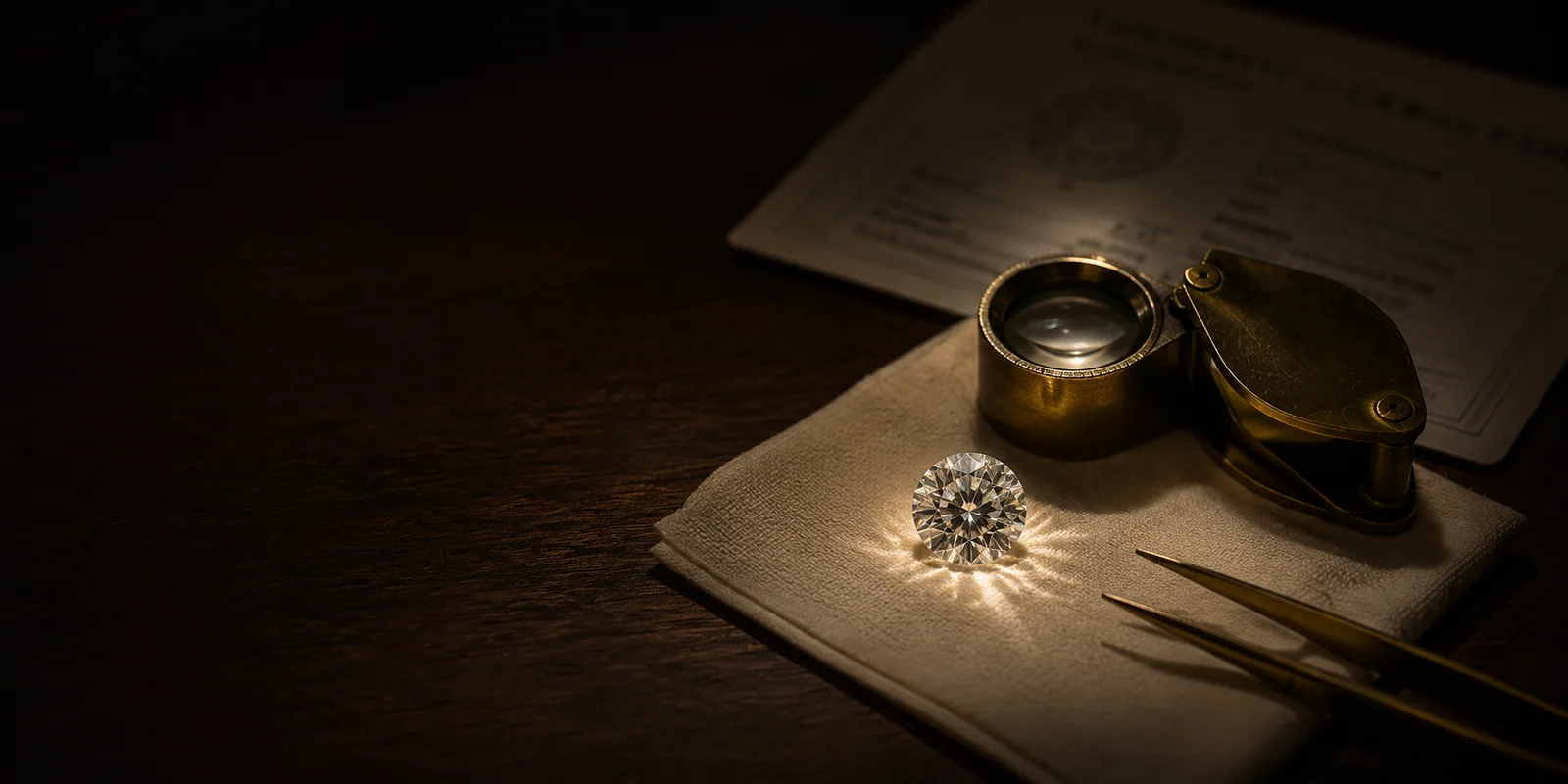
A diamond certificate looks like a page of numbers and tiny print, and most people nod along without really reading it. That is exactly how a weaker stone gets sold as a stronger one. The good news is that you do not need a gemmology degree to read a certificate well. You need to know which lines matter, and how to check that the stone in front of you is the one the paper describes.
Here is how we walk our customers through it, step by step, before any money changes hands.
Why the certificate is the whole point
A diamond certificate, also called a grading report, is an independent laboratory’s assessment of a stone. The lab has no stake in the sale. It measures the diamond and records exactly what it is. Without that report you are trusting the seller’s word on quality, and quality is most of the price.
Since lab-grown diamonds became common, the report matters even more. A lab-grown stone can look identical to a mined one to the naked eye. The certificate is what tells you which you are holding, and the two are priced very differently.
GIA and IGI, and the difference between them
Two labs come up most often in India. GIA, the Gemological Institute of America, is the global benchmark and is known for strict, consistent grading. IGI, the International Gemological Institute, is widely used in India and is the common choice for studded and bridal diamond jewellery.
Both are reputable. A GIA report tends to carry a small premium because of its reputation for tight grading, so for a single important solitaire many buyers prefer it. For bridal sets with many smaller stones, IGI is standard and sensible. What matters is that the report comes from a recognised lab, not a name you have never heard of.
The four Cs, and which ones to care about
Every report grades four things. People call them the four Cs.
Cut
Cut is how well the diamond is shaped and polished, and it decides how much the stone sparkles. For a round diamond, look for Excellent or Very Good. This is the one we tell people not to compromise on, because cut is what your eye actually sees.
Colour
Colour is graded from D, which is colourless, down through the alphabet as a faint warmth creeps in. D to F is colourless. G to J is near colourless and looks white in a finished piece to most eyes. You rarely need to pay for D when H looks just as white set in gold.
Clarity
Clarity measures the tiny natural marks inside a stone, called inclusions. The scale runs from Flawless down to Included. For most buyers, VS1 or VS2 is the sweet spot: the marks are there but invisible without magnification, so you are not paying for a perfection you cannot see.
Carat
Carat is weight, not size, though the two are linked. A heavier stone costs more per carat as well as in total. A small step down, say from 1.00 to 0.90 carat, can save a noticeable amount while looking almost the same on the hand.
How to verify the stone matches the report
- Check the report online. GIA reports can be confirmed at gia.edu, and IGI reports at igi.org. Enter the report number and match the carat, cut, colour, and clarity on screen against the paper. Every detail should agree.
- Find the laser inscription. Most modern reports note that the report number is laser-engraved on the diamond’s girdle, the thin edge around its middle. Ask for a 10x loupe and look for it. It should read the same number as the report.
- Read the proportions. The report lists the table percentage and depth percentage. For a round brilliant in the Excellent range, the table is usually around 54 to 58 percent and the depth around 60 to 62.5 percent. Numbers far outside that are worth asking about.
Two minutes on the lab’s website, a 10x loupe, and the report in your hand. That is all it takes to know the stone is what the paper says.
Red flags to watch for
- No report at all for a stone of any real size.
- A report from a lab you cannot find or verify online.
- Details on the paper that do not match what you see on the screen.
- A seller who is reluctant to hand you a loupe or let you check the number yourself.
Questions we hear often
Is a GIA diamond better than an IGI diamond?
Not by itself. The stone is the stone. GIA is known for stricter grading, so its report carries extra confidence and often a small premium. IGI is reputable and standard for bridal jewellery in India. Both are fine when the report is genuine.
Do small diamonds need certificates?
Very small accent stones are usually not certified one by one, and that is normal. For any centre stone or solitaire of about 0.30 carat and above, ask for a report.
Can I trust a certificate the shop printed itself?
No. The report must come from an independent lab, not from the seller. A shop’s own printout is a claim, not a certificate.
At Solitaire we do these checks with you, out in the open, before you pay. Every diamond of 0.30 carat and above that we sell is graded by GIA or IGI, and the report goes home with the piece. If you are buying a certified diamond anywhere, do the checks yourself. It takes a few minutes and it is your right as the buyer. Come and see us in Swaroop Nagar and we will show you exactly how.